Indian Rummy (13-Card Rummy)
Play 13-card rummy free in your browser, and learn every rule: jokers, pure sequences, sets, declaring, dropping and the count.


Play 13-card rummy free in your browser, and learn every rule: jokers, pure sequences, sets, declaring, dropping and the count.
Indian Rummy, also called 13-card rummy or Paplu, is the rummy most people in India grow up with, and it is especially popular in Maharashtra. It is played with two decks and their printed jokers, every player gets 13 cards, and one card turned up at the start makes a whole rank wild. Nobody puts cards on the table during play: you arrange your hand in secret and declare when all 13 cards fit into groups. The one rule everybody has to learn is that a winning hand needs at least two sequences, and one of them must be pure.
Below you can play Indian Rummy free against the computer, with your cards grouped and counted for you. After the game come the full rules: jokers, pure and impure sequences, sets, how a turn works, dropping, declaring, the scoring with worked examples, the points, deals and pool formats, and the odds of what your first 13 cards hold.
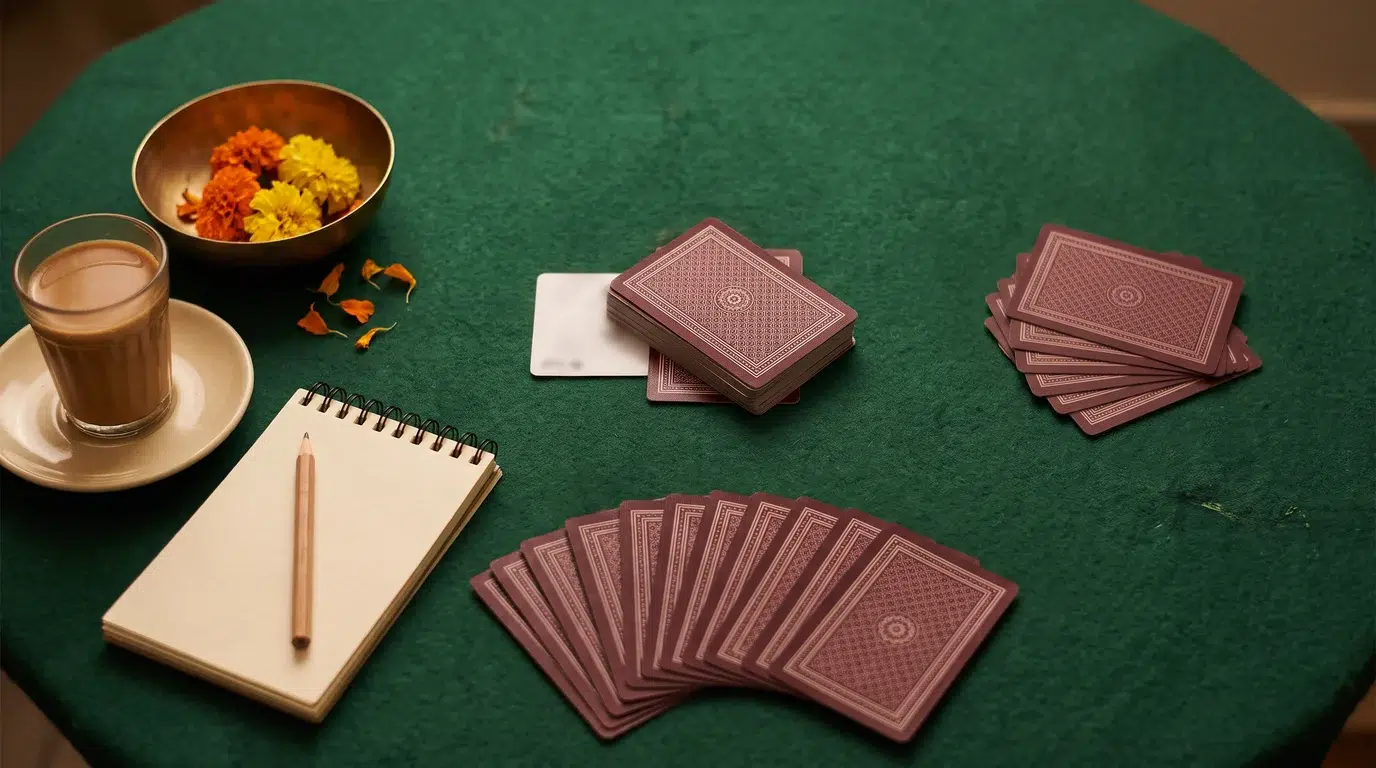
On your turn, take the top card of the closed deck or the open card, then tap a card and discard it. Your hand is sorted into pure sequences, sequences and sets automatically, and your current count is shown underneath. When the 13 cards you keep make a valid hand, the Declare button lights up. With a poor hand you can Drop before drawing. Three deals are played and the lower total wins.
The game uses the rules most apps use: two decks with two printed jokers, a first drop costs 20 points and a later drop 40, a losing hand counts at most 80 points, and if the closed deck runs out the deal is void and nobody scores.
| Indian Rummy (13-card rummy) | |
|---|---|
| Players | 2 to 6 (more with a third deck) |
| Cards | Two 52-card decks plus two printed jokers: 106 cards |
| Cards each | 13 |
| Wild cards | The printed jokers and every card of the rank turned up at the start |
| Aim | Arrange all 13 cards into sequences and sets |
| To declare | At least two sequences, one of them pure (no joker); the rest sequences or sets |
| Card values | A, K, Q, J and 10 count 10; 2 to 9 face value; jokers 0 |
| Losing hand | Ungrouped cards count against you, at most 80 points |
| Drop | First drop 20 points, middle drop 40 (10 and 40 in the traditional game) |
| Formats | Points rummy, deals rummy, pool rummy (101 or 201) |
Up to six players use two standard decks, each with one printed joker added, which makes 106 cards. Before play, one card is turned face up. Every card of the same rank as that card is a wild joker for the deal, and so are the printed jokers. If the turned-up card is itself a printed joker, the only wild card for that deal is the other printed joker (some groups play that all Aces are wild instead).
A joker can stand in for any card you need in a sequence or a set. A wild-rank card can also be used as itself: if 8s are wild, 7-8-9 of one suit is still a pure sequence because the 8 is just an 8 there.
| Card | Points if it is left ungrouped |
|---|---|
| Ace, King, Queen, Jack, 10 | 10 each |
| 2 to 9 | Face value (a 7 counts 7) |
| Printed jokers and wild-rank cards | 0 |
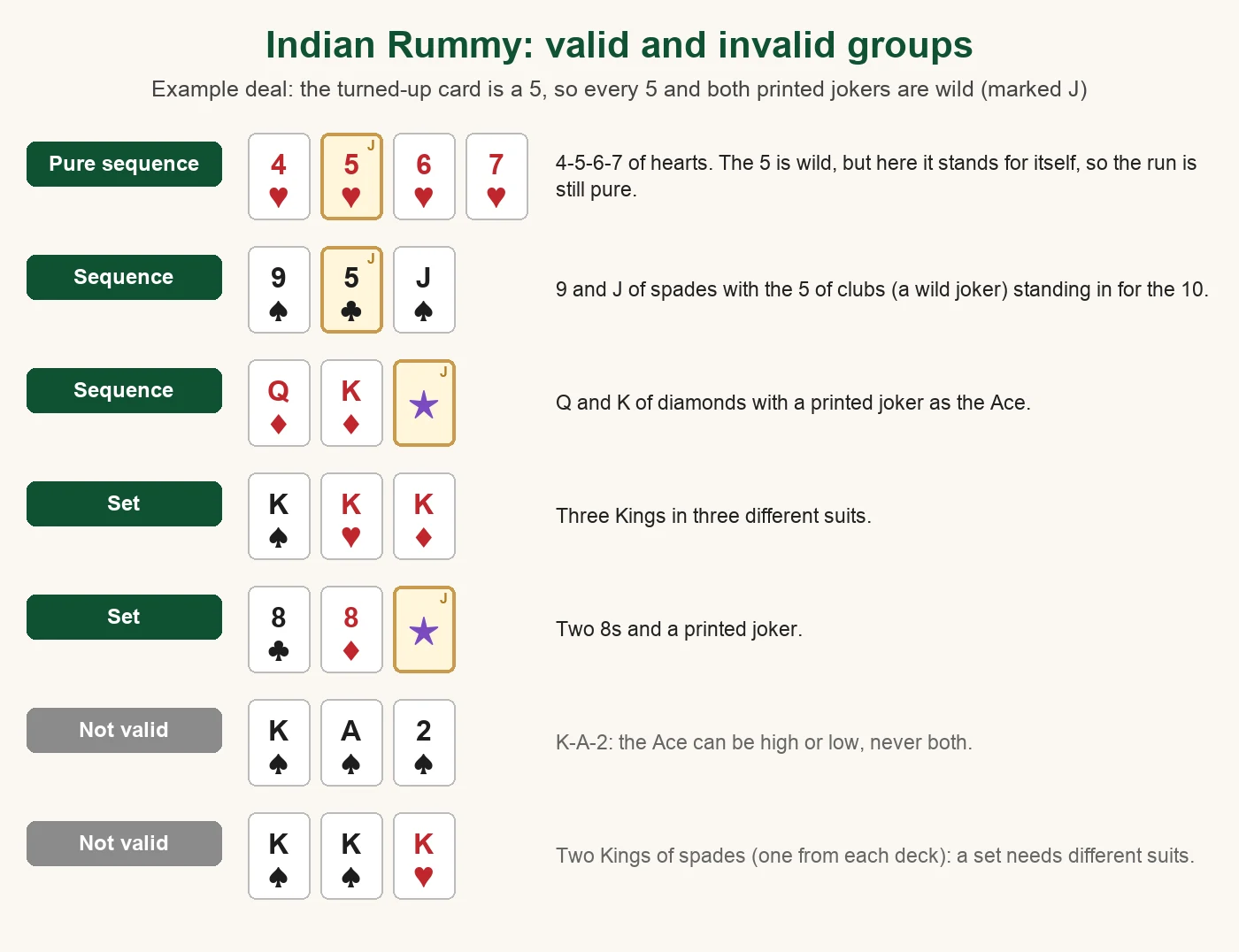
All 13 cards must be in groups, with at least two sequences, one of them pure. The pure sequence is often called the first life and the second sequence the second life. Most winning hands are four groups, one of four cards and three of three, but five-four-four or five-five-three works too, as long as the two sequences are there.
| Hand (13 cards) | Valid? |
|---|---|
| Pure sequence + sequence with a joker + two sets | Yes |
| Two pure sequences + a set + a sequence with a joker | Yes |
| Pure sequence + three sets | No: only one sequence |
| Three sequences with jokers + a set | No: none of the sequences is pure |
| Pure sequence + sequence + set, one card left over | No: every card must be in a group |
Declaring with a hand that does not qualify is an invalid declaration, and it costs the declarer 80 points. In the game above the Declare button only lights when your hand is valid, so you cannot make that mistake.
If your cards look hopeless you can drop out of the deal, but only at the start of your turn, instead of drawing. In most apps a first drop (before your first draw) costs 20 points and a middle drop (any later turn) costs 40. The traditional home game, where this is called packing, charges 10 and 40.
The player who declares a valid hand scores 0. Everyone else counts their cards, and how much counts depends on what they managed to make:
| Your hand when someone declares | What counts against you |
|---|---|
| No pure sequence | Every card, even ones in sets or impure sequences |
| A pure sequence but no second sequence | Every card except the pure sequence |
| A pure sequence and a second sequence | Only the cards outside your groups |
| Any hand | At most 80 points |
Here is the same kind of hand three ways, in a deal where 7s are wild:
| Hand | Groups | Count |
|---|---|---|
| 3♥ 4♥ 5♥ 9♠ 10♠ 7♣ Q♦ Q♣ Q♠ K♥ 8♦ 2♣ 5♠ | Pure 3-4-5 of hearts, sequence 9-10 of spades with the 7 as the Jack, set of Queens | 25: only K, 8, 2 and 5 count |
| 3♥ 4♥ 5♥ 9♠ 10♠ 6♦ Q♦ Q♣ Q♠ K♥ 8♦ 2♣ 4♠ | Pure 3-4-5 of hearts, but no second sequence | 79: everything but the pure sequence counts, Queens included |
| 3♥ 4♥ 6♥ 9♠ 10♠ 7♣ Q♦ Q♣ Q♠ K♥ 8♦ 2♣ 4♠ | No pure sequence | 86, capped at 80 |
The lesson in those three rows: the pure sequence and the second sequence are worth far more than the cards in them, because until you have both, your sets do not protect anything.
| Format | How it works |
|---|---|
| Points rummy | A single deal. The losers’ counts are settled straight away, each point worth an amount agreed in advance. |
| Deals rummy | A fixed number of deals, usually 2 or 3. The lowest total after the last deal wins. The free game on this page is deals rummy over three deals. |
| Pool rummy | Counts add up from deal to deal; a player who reaches the limit (101 or 201) is out, and the last player left wins. |
| Rule | What changes |
|---|---|
| Paplu | The card one above the turned-up joker in the same suit is the Paplu. It works as a joker, and the player holding it collects a bonus from every other player at the end of the deal. |
| Printed joker turned up | Normally only the other printed joker is wild. Some play that all Aces become wild instead; others double the scores for that deal. |
| Hand rummy | A player dealt 13 cards that already make a valid hand can declare at once, before drawing. |
| Closed deck runs out | Either the deal is void, or the open pile is shuffled and turned over as a new closed deck. |
| Nothing wild | Played with no jokers or wild cards at all, so every sequence is pure. |
| Three decks | For seven or more players, a third deck is added (159 cards). |
These figures are for a two-player game with two decks and two printed jokers. The joker figures are exact; the pure-sequence figure is from a simulation of 1,000,000 deals, and the counts come from our game engine on 20,000 deals.
| In the 13 cards you are dealt | Chance |
|---|---|
| A pure sequence already made | 36.6% |
| At least one joker (printed or wild) | 70.0% |
| Two or more jokers | 30.2% |
| Three or more jokers | 7.9% |
| Average number of jokers | 1.1 |
| A hand that would count the full 80 if someone declared at once | 47.7% |
| A complete hand on the deal (hand rummy) | about 7 in 10,000 |
So almost two hands in three start with no pure sequence (63.4%), and nearly half start at the 80-point maximum. That is why the first job in every deal is the pure sequence, and why the 20-point first drop is worth considering with a really poor hand.
Start with our guide to rummy for the basic game and every major variant, or try two-player gin rummy, where you knock instead of declaring. For other card games popular in India, read our guides to Teen Patti, Callbreak and Twenty-Nine (29), each with a free game to play.

After going through several successful experiences with several industry pioneers, Fadi Hayek has managed to excel in the world of content for online gaming by providing unique content for several projects that allowed him to obtain the necessary experience to launch his career. Last but not least, Fadi also holds several certificates, including but not limited to content marketing and iGaming.