Pallanguzhi
Play Pallanguzhi (Pallankuzhi, Pallanguli) free in your browser against the computer and learn every rule: sowing, pasu, captures, rubbish pits and how to win.


Play Pallanguzhi (Pallankuzhi, Pallanguli) free in your browser against the computer and learn every rule: sowing, pasu, captures, rubbish pits and how to win.
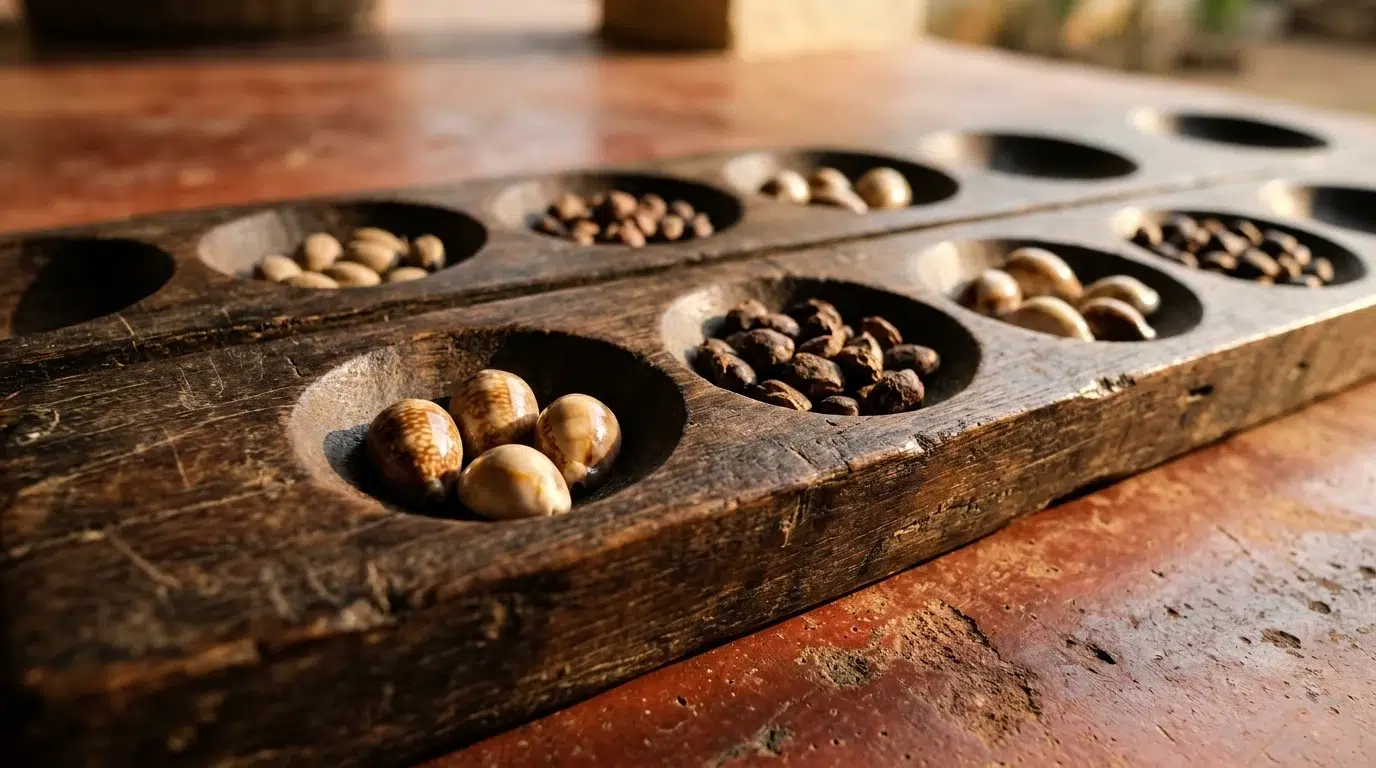
Pallanguzhi (also written Pallankuzhi, Pallanguli or Pallankuli) is the traditional mancala game of South India, played on a board of 14 pits, seven on each side, with cowry shells or tamarind seeds. In Tamil, pal means “many” and kuzhi means “pit”. You sow seeds round the board, keep going from the next pit, capture seeds that sit beyond an empty pit, and take any pit that reaches four seeds, called pasu.
It is played in Tamil Nadu and Kerala and also in Karnataka, Andhra Pradesh and Sri Lanka, where it goes by names such as Alaguli Mane and Vamana Guntalu. It belongs to the same family as Mancala and the Filipino Sungka. Play Pallanguzhi free below against the computer, then read the full rules, the names in each language, the variations and some tips.
You play the bottom row against the computer, which plays the top row. Tap one of your pits to lift its seeds and sow them counter-clockwise: left to right along your row, then right to left along the computer’s. The game does the rest of the turn for you, including every pasu and capture, and the message under the board tells you what was taken. Your store is on the right, the computer’s on the left. Switch between Easy and Hard at the top.
In the free game each pit starts with 6 seeds, the starting player alternates from game to game, and at the start of a later round your pits are refilled from pit 1 along your row, so any rubbish pits (marked ×) are at the end of your row. A game goes on until one player cannot fill a single pit with six seeds.
| Pallanguzhi | |
|---|---|
| Other names | Pallankuzhi, Pallanguli, Pallankuli, Pallam Kuzhi; Alaguli Mane (Kannada), Vamana Guntalu (Telugu), Kasari (Odia), Satkoli (Marathi) |
| Players | 2 |
| Board | 2 rows of 7 pits, 14 in all (also called “fourteen pits”, pathinalam kuzhi) |
| Seeds | 6 in each pit, 84 in all (some regions use 4 or 5 per pit) |
| Counters | Cowry shells, tamarind seeds or small pebbles |
| Direction | Counter-clockwise |
| Captures | The pit beyond an empty pit, and any pit that reaches 4 seeds (pasu) |
| Aim | Capture seeds until your opponent cannot fill a single pit with six |
Put the board between the two players so that each has a row of seven pits in front of them. Place six seeds in every pit. Each player keeps the seeds they capture in a store beside the board.
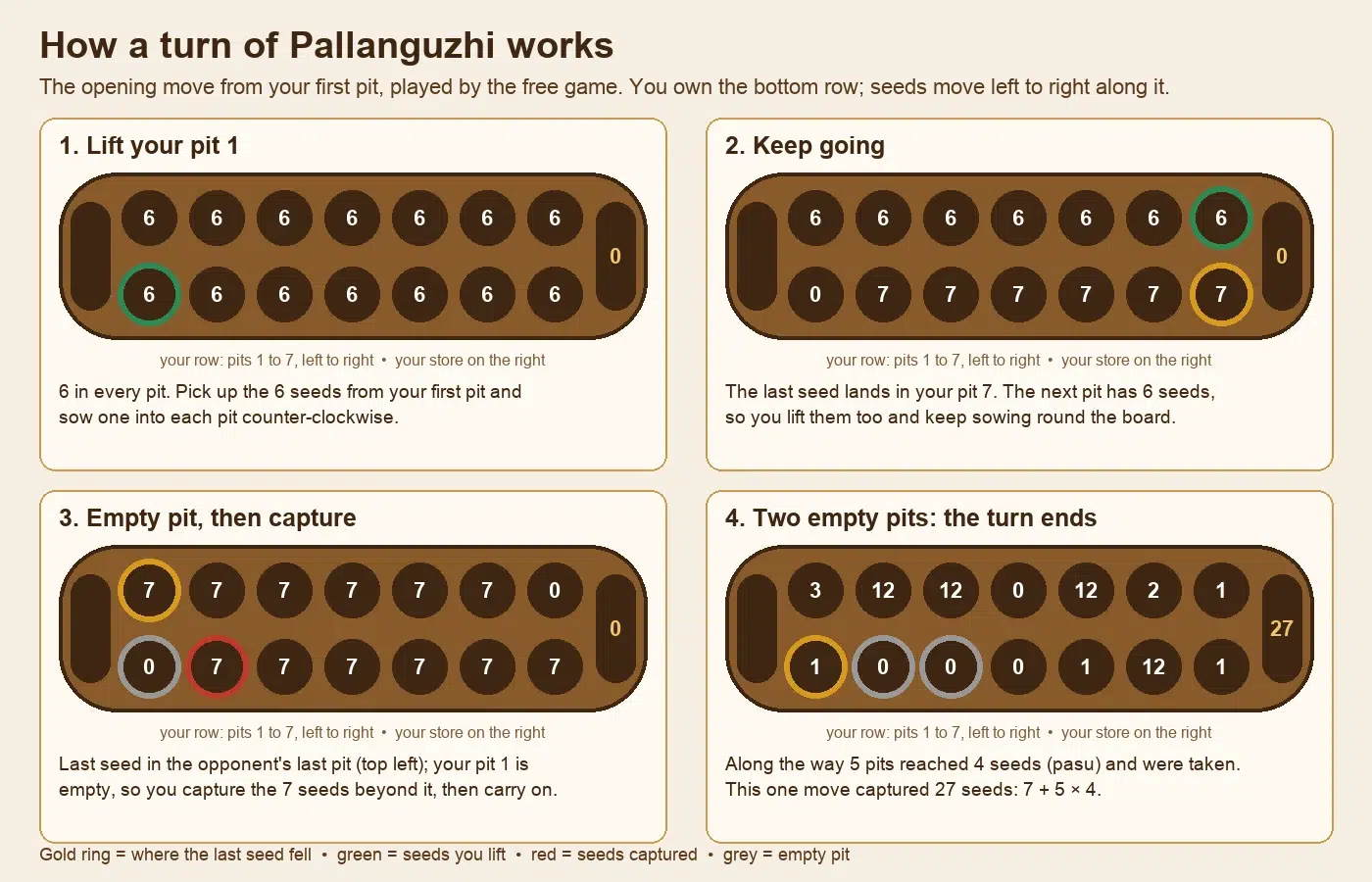
On your turn, lift all the seeds from any one of your own pits and drop them one at a time into the following pits, going counter-clockwise. When you reach the end of your row, carry on along your opponent’s row.
When you drop your last seed, look at the next pit. If it has seeds, lift them all and keep sowing in the same way. A single turn can go round the board several times like this.
If the pit after your last seed is empty, you capture all the seeds in the pit beyond it and put them in your store. Then, if the pit after the one you captured has seeds, lift them and carry on sowing.
Whenever a seed you drop makes a pit hold exactly four seeds, you capture those four at once. This is called pasu, and it applies to pits on either side of the board.
If your last seed is followed by two empty pits, nothing is captured and your turn is over. Your turn also ends after a capture when the next pit is empty. Then your opponent plays from one of their pits in the same way.
| After your last seed… | What happens |
|---|---|
| The next pit has seeds | Lift them and keep sowing |
| The next pit is empty, the one after has seeds | Capture the seeds beyond the empty pit, then keep sowing from the next pit if it has seeds |
| The next two pits are empty | Your turn ends with nothing captured |
| Any pit reaches 4 seeds while you sow | Pasu: you take those 4 at once |
When a player has no seeds left to move on their turn, the round is over and their opponent captures all the seeds still on the board.
Pallanguzhi is usually played over several rounds. After a round, each player takes the seeds from their store and fills as many of their own pits as they can with six seeds each. The winner of the round has seeds left over, which stay in their store. The loser cannot fill every pit, and the pits they cannot fill are rubbish pits: nobody sows into them and they are skipped for the whole round.
The player who went first in the previous round goes second in the next. If, after a later round, a player has enough seeds to fill a rubbish pit again, it comes back into play. The game is over when a player cannot fill even one pit with six seeds at the end of a round; the other player wins.
Searching for the game in another language? These are the names for the same board of fourteen pits:
| Language or country | Name |
|---|---|
| Tamil | Pallanguzhi, Pallankuzhi, Pallanguli, Pallankuli (பல்லாங்குழி) |
| Malayalam | Pallankuzhi (പല്ലാങ്കുഴി) |
| Kannada | Alaguli Mane, often written Ali Guli Mane |
| Telugu | Vamana Guntalu |
| Odia | Kasari |
| Marathi | Satkoli |
| Indonesia and Malaysia | Congkak (related game) |
| Philippines | Sungka (related game) |
These come from the free game’s own engine, which plays the rules on this page:
| Question | Answer |
|---|---|
| How much does the first move capture? | With 6 seeds per pit, every opening pit captures exactly 27 seeds (5 pasu of 4 plus one capture of 7), about a third of the board |
| What can the second player take back? | Whichever pit opens, the second player’s best reply captures 30 to 38 seeds, more than the opening took |
| Does the first player win the round? | Only 28% of the time in 4,000 first rounds between two Easy computer players |
| How long is a round? | About 18 moves on average, won by about 12 seeds |
| Does looking ahead help? | Yes: Hard (which also counts your best reply) beat Easy in all 1,000 test games, usually within 4 rounds |
So the opening grab looks decisive but is not: the board it leaves behind lets the second player take even more straight back.
Henry Parker described Pallanguzhi in his 1909 book Ancient Ceylon, and it has long been played by Tamils in South India and northern Sri Lanka, mostly by women and children. Families played with tamarind seeds, cowry shells or pebbles, and in the countryside women scooped the pits out of the mud. The game appears in Tamil devotional songs, including a kriti about Rama and Sita playing Pallanguzhi together, and in 2006 the Government Museum in Tiruchirappalli held a Pallanguzhi tournament for women.
Tamil communities took it to Sri Lanka, Malaysia, Singapore, Trinidad and Guyana, and close relatives are played as Congkak in Indonesia and Malaysia and as Sungka in the Philippines. It is still encouraged for children, because counting seeds quickly is good practice for mental arithmetic.
Another cowry-shell game: Ashta Chamma (Chowka Bara, Thaayam), the race game where four shells decide your move and you must hit an opponent before you can head for home. Free to play online.

After going through several successful experiences with several industry pioneers, Fadi Hayek has managed to excel in the world of content for online gaming by providing unique content for several projects that allowed him to obtain the necessary experience to launch his career. Last but not least, Fadi also holds several certificates, including but not limited to content marketing and iGaming.