Chinese Checkers
Play Chinese checkers free against the computer, then learn how to set up and play for two to six players: steps, hop chains and how to win the race.


Play Chinese checkers free against the computer, then learn how to set up and play for two to six players: steps, hop chains and how to win the race.
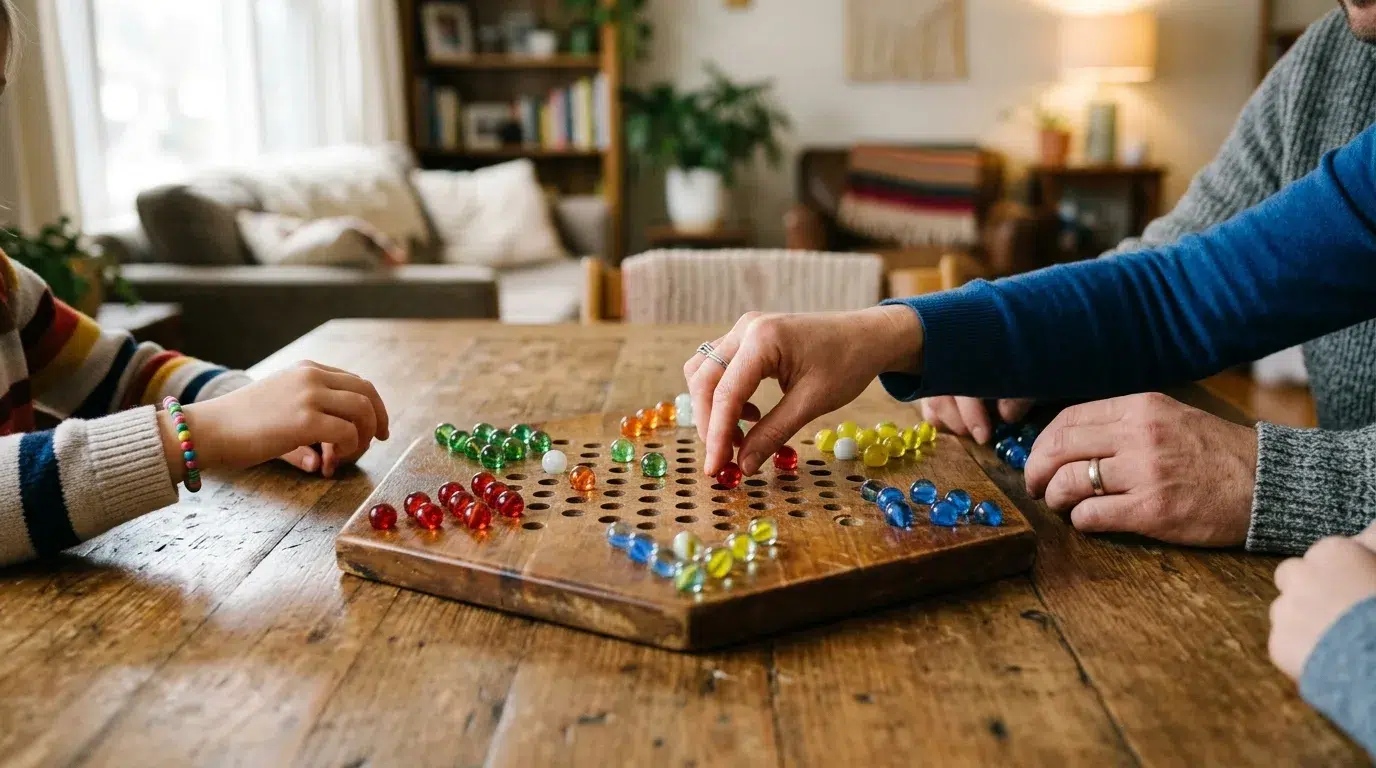
Chinese checkers (Chinese chequers in the UK) is a race game for two to six players on a star-shaped board. Each player starts with ten marbles in one point of the star and tries to be first to move them all into the point directly opposite, by stepping to the next hole or hopping over other marbles. Nothing is captured, so the game is all about building long chains of hops for yourself and blocking the ones your opponents need. Despite the name, it is neither Chinese nor a form of checkers: it was invented in Germany in 1892. You can play Chinese checkers free right here against the computer, with two or three players, and this guide covers how to play Chinese checkers, the set-up for every number of players, the variations, and the strategy that wins the race.
You are red and start in the bottom point of the star. Tap one of your marbles and every hole it can reach lights up, including the end of every hop chain, then tap the hole you want. Choose 2 players to race the computer to the opposite point, or 3 players to race two computer players, each starting in alternate points and heading for the empty point opposite. Easy looks one move ahead; Hard also plans its next move.
The free game uses the standard rules: a move is one step to a neighbouring hole, or a chain of hops over single marbles of any colour, and you can stop the chain wherever you like. Two choices are made for you, because the rules leave them open. A marble may hop through a point that is neither its start nor its target but may not stop there. And to stop anyone blocking by never leaving home, an opponent’s marble still sitting in its own start point, which is your target, counts as filling that hole once you have at least one marble in the target. So move your marbles out of your starting point: a player who leaves them there can lose before the race is over. The first player alternates from game to game.
| Chinese checkers | |
|---|---|
| Players | Two, three, four or six. |
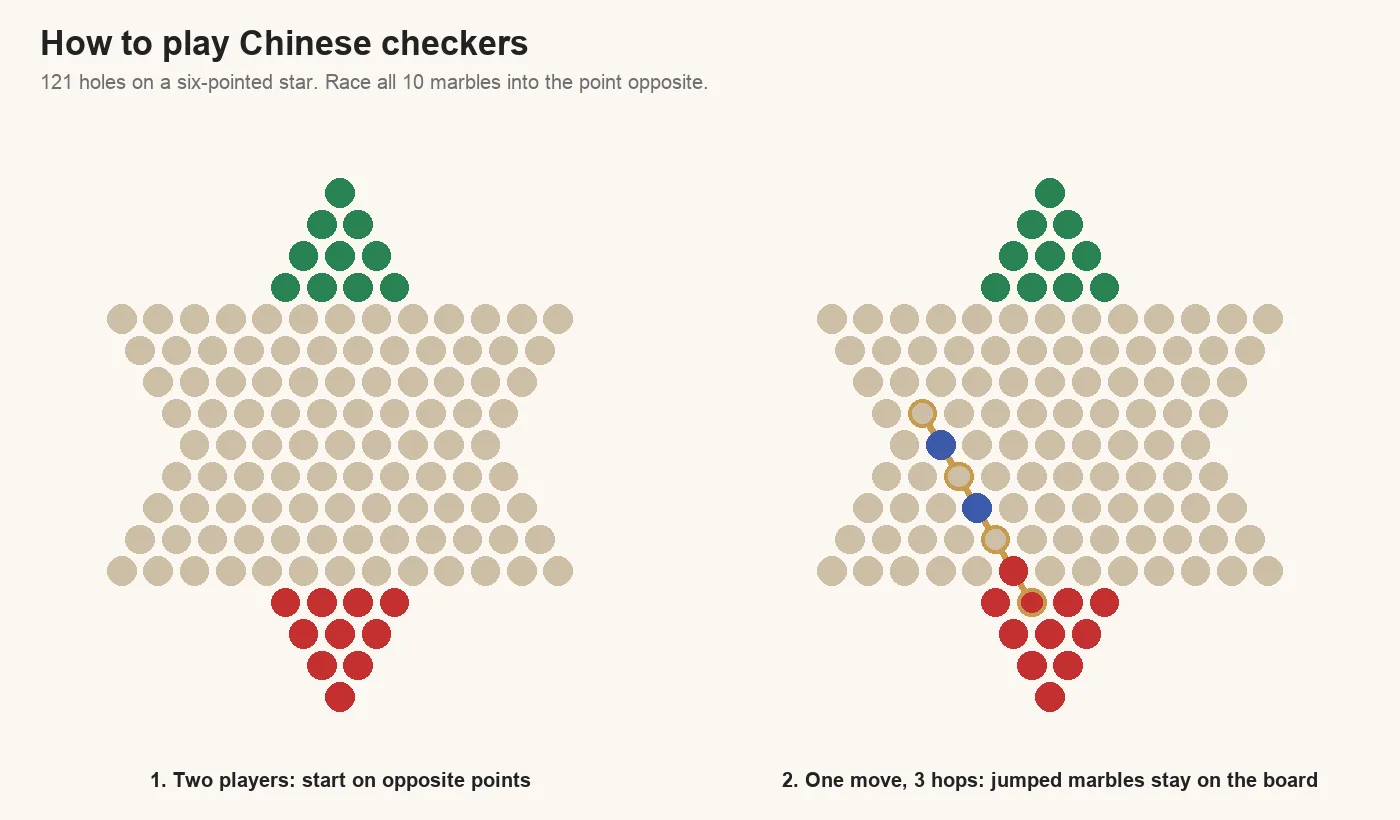
| Board | A six-pointed star with 121 holes; each point holds 10. |
| Pieces | 10 marbles or pegs per player (15 in some two-player games). |
| Goal | Be first to move all your marbles into the point opposite your start, called your home. |
| Moves | Either one step to an adjacent empty hole, or one or more hops over single marbles into the empty hole beyond. |
| Captures | None. Marbles that are hopped over stay on the board. |
| Turn order | Clockwise around the board. |
| Players | Set-up |
|---|---|
| Two | Start on opposite points, so each of you races into the other’s start. Some players use 15 marbles each, or two or three sets each. |
| Three | Use three alternate points, so everyone races into an empty point. Or play two sets each, on opposite points. |
| Four | Use two pairs of opposite points and leave the remaining two points empty. |
| Six | Every point is used. Play every player for themselves, or in three teams of two with partners on opposite points. |
| Variation | How it differs |
|---|---|
| Fast-paced (Super Chinese checkers) | Popular in France: you can hop over a marble that is not next to you, landing the same distance beyond it. Only one marble may be in the way. |
| Capture | All 60 marbles start in the central hexagon. Players hop any marble over any other and keep the ones they jump; only hops are allowed, and the most captured marbles wins. |
| Diamond game | Played in Japan and South Korea, usually on a smaller 73-hole board with 10 pieces, or 15 on the full board; each side usually has one king piece, which ordinary pieces cannot jump over. |
| Order out of chaos | Marbles start mixed up in the centre, and players race them out to their home points. |
| Halma | The 1880s original: a 16×16 square board, 19 pieces each for two players or 13 for four, and moves in all eight directions. |
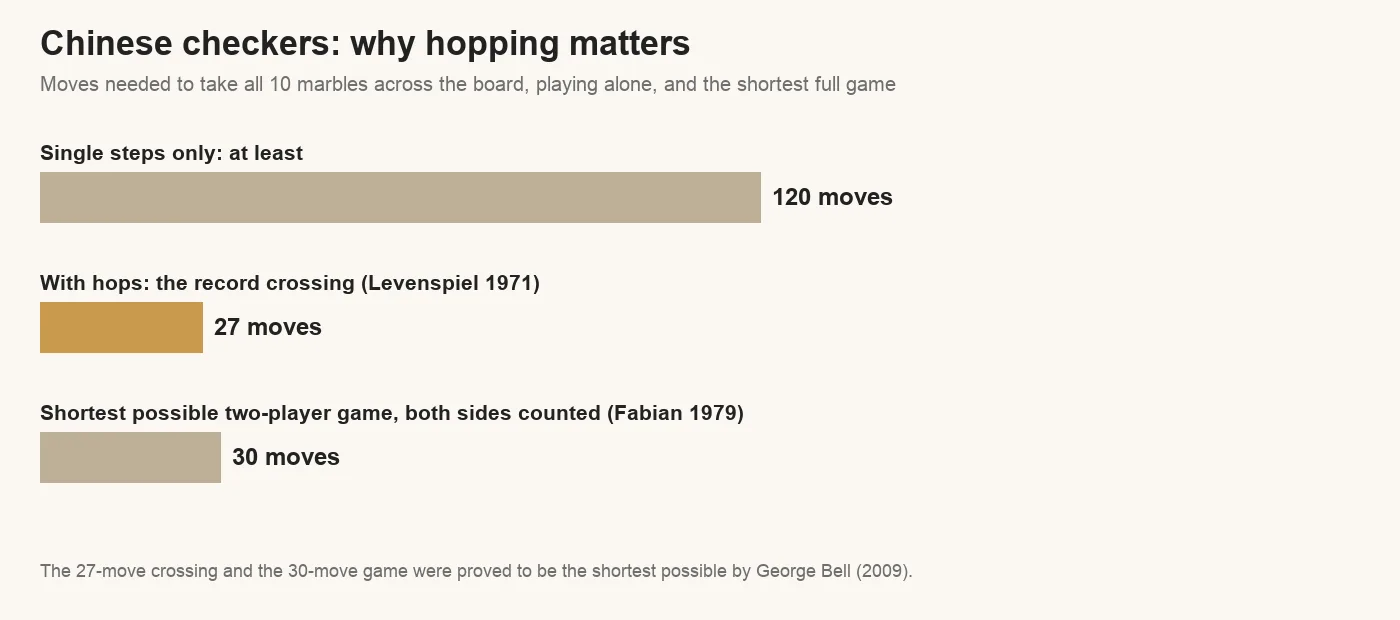
From the starting position of a two-player game, there are exactly 14 possible first moves. With single steps alone, taking ten marbles across the board needs at least 120 moves, because the marbles together have to cover that many holes. With hops, the record is far lower: Octave Levenspiel found a way to move all ten marbles across an empty board in 27 moves in 1971, and in 2009 George Bell used computer search to prove that no faster crossing exists.
The shortest possible complete game is 30 moves, 15 by each player, first found by David Fabian in 1979 and also proved optimal by Bell. It only works if both players cooperate to finish as fast as possible, but it shows that a sharp game can be much quicker than the game’s slow reputation suggests.
Real games are slower than the record. In 400 games between two Easy computer players the winner needed a median of 56 moves, and two Hard players about 43. Around 61% of all moves were hops, the longest single chain was 13 hops, and the player who moved first won about 55% of the time: a small edge, as in most race games. The Hard computer beat the Easy one in 187 of 200 games, which shows how much one move of planning ahead is worth.
The game started as Halma, invented in 1883 or 1884 by George Howard Monks, an American surgeon at Harvard Medical School, and played on a 16×16 square board. In 1892 a German version moved it onto a star-shaped board as Stern-Halma (“star Halma”), the name it still has in Germany. The name “Chinese checkers” was a marketing idea of Bill and Jack Pressman in the United States in 1928; their first version was sold as “Hop Ching checkers”. In China the game is now known as tiaoqi, “jump game”.
For the classic game of jumps and kings on a square board, see checkers or chess. For another strategy game for two, try mancala or backgammon.
Another family race game: Trouble, where you pop a 6 to get out and bump other pegs back home.
Try a game of aim: how to play carrom, with the official rules and scoring.
Try a two-player classic: Nine Men’s Morris, where three in a row takes one of your opponent’s men. Rules, strategy and a free game against the computer.
Prefer to puzzle on your own? Try Sudoku: the rules, the techniques for hard grids and a free game.

After going through several successful experiences with several industry pioneers, Fadi Hayek has managed to excel in the world of content for online gaming by providing unique content for several projects that allowed him to obtain the necessary experience to launch his career. Last but not least, Fadi also holds several certificates, including but not limited to content marketing and iGaming.