Plinko
One ball, a triangle of pegs and a slot at the bottom — and an x1,000 payout that sits on exactly one path in 65,536.


One ball, a triangle of pegs and a slot at the bottom — and an x1,000 payout that sits on exactly one path in 65,536.
Plinko came off an American game show, moved to crypto casinos, and is now in
almost every online lobby that carries instant games. A ball drops into a triangle of pegs, bounces
its way down, and lands in one of the slots along the bottom. Each slot pays a multiplier of the
bet. That is the entire game — there are no cards to read, no reels, and nothing to do after
the drop.
What there is instead is a shape. The slots at the edges pay hundreds of times the stake and the
ones in the middle pay a fraction of it, and the reason is that the ball almost never reaches the
edges. Most pages about this game describe the board and stop. This one gives the numbers: how often
each slot actually comes up, what the two studio versions return, and why no predictor can work.
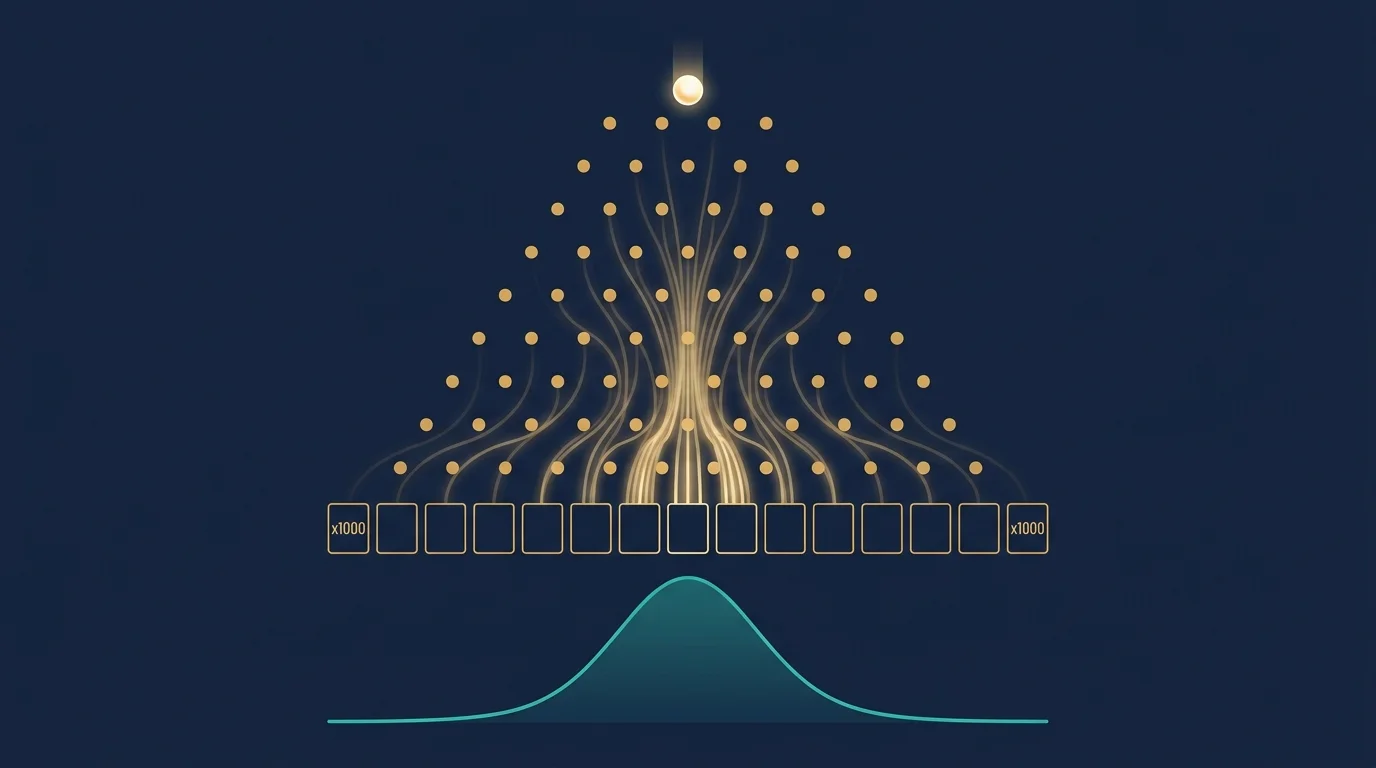
A Plinko board is a binomial machine. At each row the ball goes left or right,
and the slot it finishes in is decided by how many of those steps went right. With 16 rows there are
216 = 65,536 equally likely paths down the board and only 17 slots to
share them between, so the paths pile up in the middle. There is exactly one path
that goes right sixteen times in a row — and that is the path to the slot paying
x1,000.
Here is that arithmetic for the three board sizes, counting slots from the far left:
| Board | Outermost slot (each side) | Second slot in | Centre slot | Centre three slots combined |
|---|---|---|---|---|
| 8 rows (9 slots, 256 paths) | 0.39% — 1 drop in 256 | 3.13% — 1 in 32 | 27.3% | 71.1% |
| 12 rows (13 slots, 4,096 paths) | 0.024% — 1 in 4,096 | 0.29% — 1 in 341 | 22.6% | 61.2% |
| 16 rows (17 slots, 65,536 paths) | 0.0015% — 1 in 65,536 | 0.024% — 1 in 4,096 | 19.6% | 54.6% |
Read the bottom row again. On a 16-row board the slot at either end comes up
once in 65,536 drops. Counting both ends together that is once in
32,768. At one drop every three seconds in Auto mode, a player would sit through roughly
27 hours of continuous play to see one, on average — and “on average” is doing
real work there, because the wait has no memory and the next drop is never more likely than the
last.
The figures assume each peg splits the ball 50/50, which is what a provably fair implementation
produces. They are computed from C(n,k) ÷ 2n, not taken from anyone’s marketing.
These two controls are where the game is usually misunderstood, so it is worth being exact.
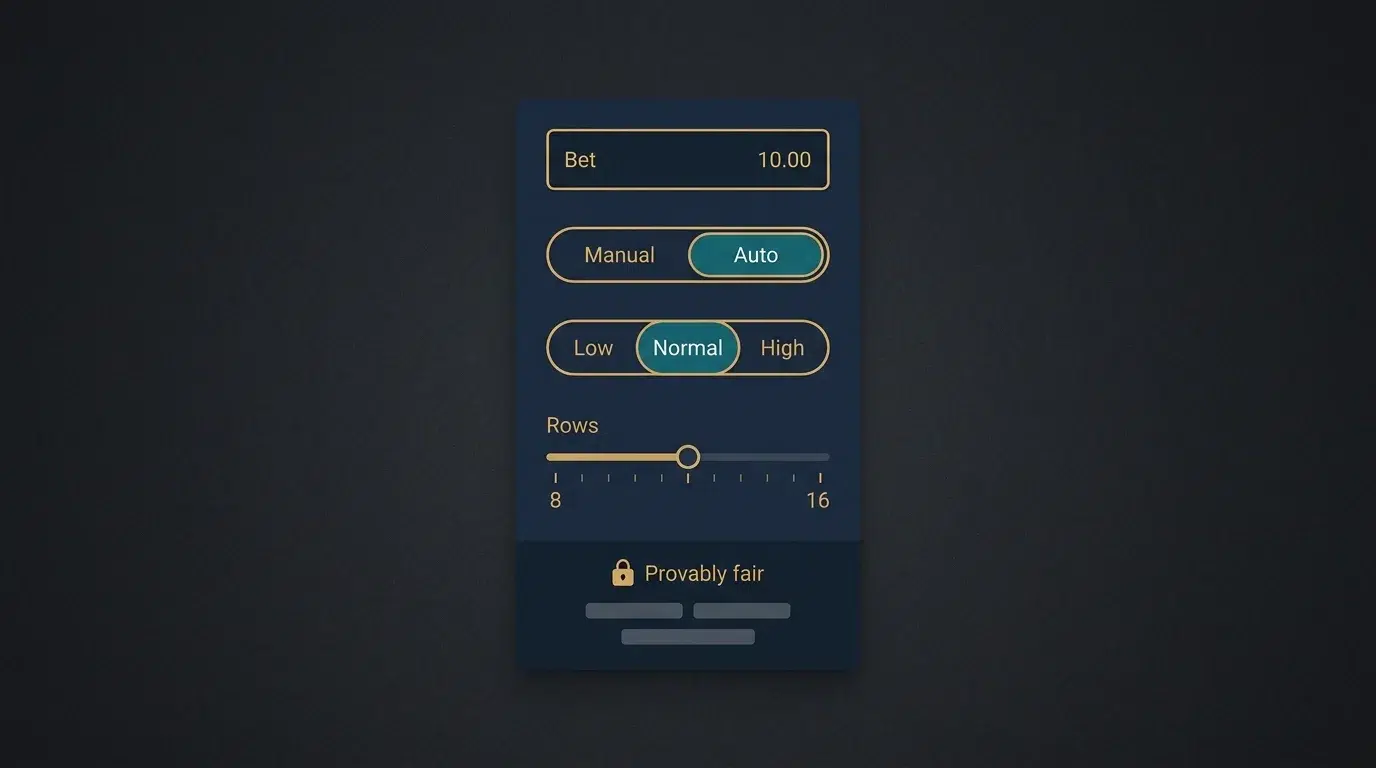
Rows change the spread. Adding rows adds slots, and because the paths keep
piling into the centre, the outer slots get rarer — the table above shows the outermost slot
falling from 1 in 256 at eight rows to 1 in 65,536 at sixteen. Studios raise the top multiplier to
match. A bigger headline number on a bigger board is not a better deal; it is the same deal further
out on the tail.
Risk changes the payouts, not the probabilities. Low, normal and high re-price
the slots: high risk pushes value out to the edges and strips it from the middle, low risk flattens
everything towards the centre. The ball behaves identically in all three. What changes is how much
of your stake is riding on outcomes that almost never happen.
Neither control alters the return to player. The studio sets that once, and it holds across every
combination of rows and risk.
Plinko is not one game. Two studios supply most of the ones in mainstream lobbies, and their
published figures are not the same.
| BGaming Plinko | Spribe Plinko | |
|---|---|---|
| Published RTP | 99% | 97% |
| Max multiplier | x1,000 | Set by pin count |
| Released | 28 January 2019 | — |
| Rows / pins | 8 to 16 lines | Adjustable pin count |
| Risk levels | Low, normal, high | Three coloured drop buttons |
| Bet modes | Manual and Auto | Autoplay with custom settings |
| Provably fair | Yes — server and client seeds | — |
| Studio licence | — | Spribe OÜ is licensed in Great Britain by the Gambling Commission, account number 57302 |
Two percentage points is a lot in this game. Over 1,000 drops of one unit each,
a 99% game gives back 990 on average and a 97% game 970. Because Plinko is played fast — Auto
mode will happily run hundreds of drops — that gap compounds much quicker than it would on a
game you play by hand. The version is worth checking before the risk level is.
Both studios publish a free demo on their own sites, so the board, the rows and the risk levels
can be tried at length without an account and without a deposit.
Search results for this game are full of predictor apps, signal groups and pattern videos. The
mechanism rules all of them out, and it does so in two separate ways.
The result is decided before the ball moves. In a provably fair implementation
the outcome comes from a server seed and a client seed combined at the start of the round. The
animation of the ball bouncing down the pegs is a rendering of a result that already exists. There
is nothing to observe mid-drop, because nothing is being decided mid-drop. The same seeds let a
player verify afterwards that the result was not altered — which is the point of the
system.
And the drops are independent. A run of centre slots does not make an edge slot
due. Each drop starts from the same distribution as the one before it, which is why a board that has
paid the middle forty times running is in exactly the same state as a fresh one. Any tool claiming
to read a pattern is claiming to read something the game does not contain.
BGaming say it plainly on their own game page: “Plinko, in fact, is extremely elementary and
random. There are no specific betting strategies.” That is the studio that built it.
| What it does well | Worth knowing |
|---|---|
| Published RTP is high for a casual game — 99% on the BGaming version | The pace is the risk: Auto mode can run through a bankroll far faster than a slot |
| The rules take ten seconds to learn, with nothing to memorise | The advertised top multiplier sits on the rarest outcome on the board |
| Provably fair on the BGaming build, verifiable per round | Bonus wagering often counts instant games at a reduced rate or not at all — check the offer terms |
| Free demos on both studios’ own sites, no account needed | Two studios, two different RTPs — the lobby does not always say which one it is running |
It is filed under instant games, casual or crash
rather than with the slots, usually next to Mines, Dice and Aviator-style titles. The quickest way to
find it anywhere is the lobby search box, since category names differ from operator to operator. The
casino games guide covers the rest of that section,
and the Mines guide and
Aviator guide work through the same
questions for the two titles usually sitting beside it.
The operator list on this page is ordered for the country you are reading from, and brands that
do not accept players from it are not shown.
18+. Plinko is a game of chance with no strategy that changes its outcome. Set a deposit
limit before you start, treat the stake as the cost of the entertainment, and stop when it is spent.
Support is available at GambleAware.

After going through several successful experiences with several industry pioneers, Fadi Hayek has managed to excel in the world of content for online gaming by providing unique content for several projects that allowed him to obtain the necessary experience to launch his career. Last but not least, Fadi also holds several certificates, including but not limited to content marketing and iGaming.