Andar Bahar
One card in the middle, two sides, one decision — and a house edge that swings from 2.15% to 5.43% depending on a number printed on the table.


One card in the middle, two sides, one decision — and a house edge that swings from 2.15% to 5.43% depending on a number printed on the table.
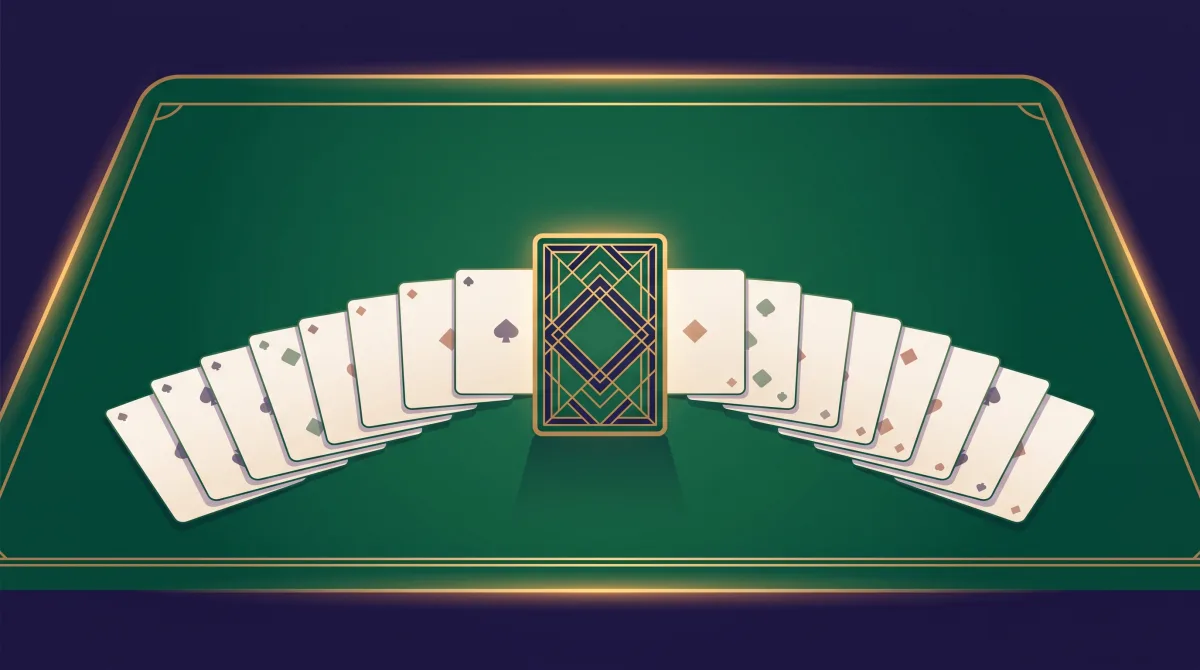
Andar Bahar is the simplest card game in any casino lobby. One card is turned
face up in the middle of the table, the dealer then deals cards alternately to either side of it,
and the round ends the moment a card matching that first card’s rank appears.
There is one decision: which side it lands on. Andar is the inside, Bahar the outside.
No hands to read, no strategy to learn, nothing to do once the bet is placed. What that leaves is
a question of arithmetic — how often each side wins, what each side pays, and which of the two
is actually worth betting. That part has a definite answer, and most pages about this game do not
give it.
Most descriptions of this game dwell on which side the dealer starts dealing to, and on the
convention that a black Middle Card starts the deal on one side and a red one on the other. It makes
for a good paragraph and it changes nothing. Which side the dealer starts on does not affect
the odds.
What decides the round is simply how many cards are dealt after the Middle Card:
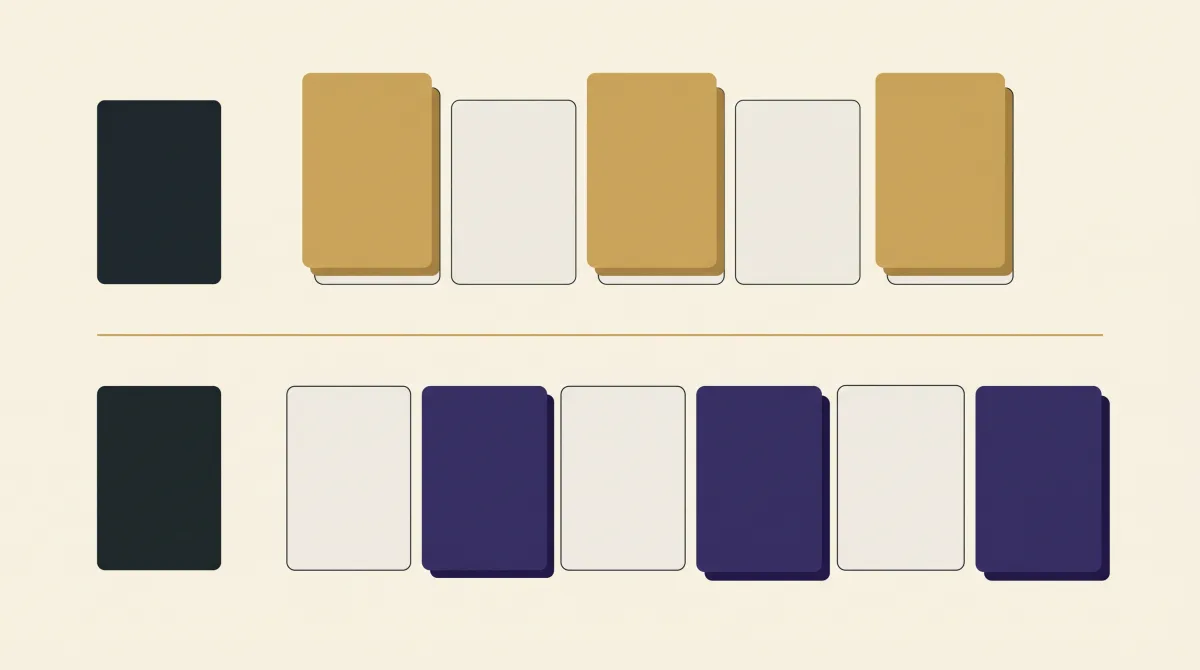
Because Andar receives the first card, it also collects every odd-numbered position — and
a round can end on the very first card, which is an odd position. That single card of a head start
is the entire edge, and it is worth exactly this much:
| Bet | Chance of winning |
|---|---|
| Andar | 51.5006% |
| Bahar | 48.4994% |
A game where one side wins 51.5% of the time cannot pay both sides evenly, so the casino shortens
the price on Andar. How far it shortens it varies by table, and that variation matters more than
anything else on this page: the same bet can be one of the best in the building or one of the worst,
depending on the number printed on the felt.
| Bet | Pays | House edge |
|---|---|---|
| Andar | 0.9 to 1 | 2.15% |
| Andar | 0.85 to 1 | 4.72% |
| Bahar | 1 to 1 | 3.00% |
| Bahar | 0.95 to 1 | 5.43% |
Three things follow. Andar at 0.9 to 1, at a 2.15% house edge, is the best bet available
in this game — better than every side bet and better than either Bahar price.
Bahar pays more per win and still costs more: it returns a tenth more on the stake
(1 against 0.9) while winning three percentage points less often, and the extra payout does not
cover the gap. And a table paying 0.85 on Andar or 0.95 on Bahar is a
different game in the only sense that matters: the edge more than doubles. The payout line
is printed on the table and in the game rules; it is the one number worth reading before the first
bet.
Rounds are short far more often than they are long. It takes 13 cards on average
to find the match, and the median is 11 — the mean is dragged upward by the
rare round that runs deep into the deck.
| Cards dealt after the Middle Card | Chance the round has already ended |
|---|---|
| 1 | 5.9% |
| 5 or fewer | 27.1% |
| 10 or fewer | 48.8% |
| 15 or fewer | 65.7% |
| 20 or fewer | 78.4% |
| 30 or fewer | 93.6% |
| 40 or fewer | 99.2% |
That distribution is what the “number of cards” side bets are priced against, and it
is why they are priced the way they are.
Tables add wagers on the Middle Card and on how long the round runs. Every one of them costs more
than the main Andar bet, and the spread between the cheapest and the dearest is wide.
| Side bet | Pays | Chance | Cost per unit staked |
|---|---|---|---|
| Round ends between 16 and 25 cards | 3.5 to 1 | 21.8% | 1.9% |
| Round ends between 6 and 10 cards | 3.5 to 1 | 21.7% | 2.3% |
| Middle Card is a specific rank | 11.45 to 1 | 7.7% | 4.2% |
| Middle Card is a specific suit | 2.8 to 1 | 25.0% | 5.0% |
| Middle Card is a specific colour | 0.9 to 1 | 50.0% | 5.0% |
| Round runs 20 or more cards | 2.9 to 1 | 23.8% | 7.1% |
| Round ends between 26 and 30 cards | 14 to 1 | 6.1% | 8.5% |
Even the cheapest of them, at 1.9%, is close to the main bet rather than better than it, and the
dearest costs four times as much. Pays differ between tables here too, so the figures above describe
the versions these prices come from rather than every table everywhere.
Two different things get called Andar Bahar online, and they do not behave identically.
A live-dealer table is the game described above, dealt from a real deck in front
of a camera, with the payout line set by the studio. This is where the 2.15% figure belongs.
A software version is dealt by a random number generator and is priced by its
own return-to-player figure instead. OneTouch’s Andar Bahar, released on
22 March 2019, publishes an RTP of 94.9% and offers side bets on
the Middle Card’s suit and on whether its rank is above or below eight. It runs in English,
Hindi and Telugu across Android, iOS, Mac and Windows, with a free demo on the studio’s own
site. Note the gap: 94.9% is a materially weaker return than a live table paying 0.9 to 1 on Andar,
and it is the RNG version that most often appears in a casino’s slots-style game list rather
than its live lobby.
Andar Bahar sits in the live-casino section rather than among the slots, alongside the other
Indian table games. Among the operators covered on this site, WinBeast is the one
whose live floor documents it by name: the tables are run by
Evolution, Pragmatic Play Live, Ezugi, LuckyStreak, Absolute Live Gaming and Live
Vegas, covering roulette, blackjack, baccarat, Andar Bahar and game shows. Its welcome package is
€5,000 plus 500 free spins and a €650 free bet at 40x wagering, and it
publishes instant withdrawals on cards and crypto with bank rails taking up to 12 hours. The full
write-up is in the WinBeast review.
Elsewhere the quickest check is the live lobby’s own search box, because studio coverage is
set per operator and per market. The other Indian games have their own guides here —
Teen Patti and
Rummy — and the
games hub lists everything reviewed on this site,
ordered for the country you are reading from.
Andar Bahar resolves in seconds, and a game that fast is easy to play far more rounds of than
intended; at roughly 13 cards a round, the edge is applied to every one of them. Decide the amount
before you sit down and treat it as spent. Local law is a separate question from whether a table
will accept you, and the two do not track each other — check what applies where you are.
Players must be of legal age in their jurisdiction. Free, confidential help is available at
GambleAware and
GamCare.
Liban Casino may earn a commission if you open an account through a link on this page. Gambling
law varies by country and is restrictive in many of them — this guide is informational, not
legal advice.
The probabilities, house-edge figures and side-bet values on this page are from the Wizard of
Odds analysis of Andar Bahar, read on 16 September 2026; the software-version figures are from
OneTouch’s own game page.

After going through several successful experiences with several industry pioneers, Fadi Hayek has managed to excel in the world of content for online gaming by providing unique content for several projects that allowed him to obtain the necessary experience to launch his career. Last but not least, Fadi also holds several certificates, including but not limited to content marketing and iGaming.